




















“I've engaged Yungle for over seven different client projects. Their speed, attention to detail, and quality of output have continually drawn me back.”

“I've engaged Yungle for over seven different client projects. Their speed, attention to detail, and quality of output have continually drawn me back.”
La mayoría de los sitios web se ven bien al lanzarse. Luego, dejan de funcionar.
Son difíciles de actualizar. Están desconectados del marketing. No están diseñados para SEO. No tienen analíticas. No consideran la conversión. Y cuando el negocio intenta crecer, el sitio no puede seguir el ritmo. La solución no es otro rediseño. Es construir el sistema correctamente desde el principio y mantenerlo en mejora constante.
CMS
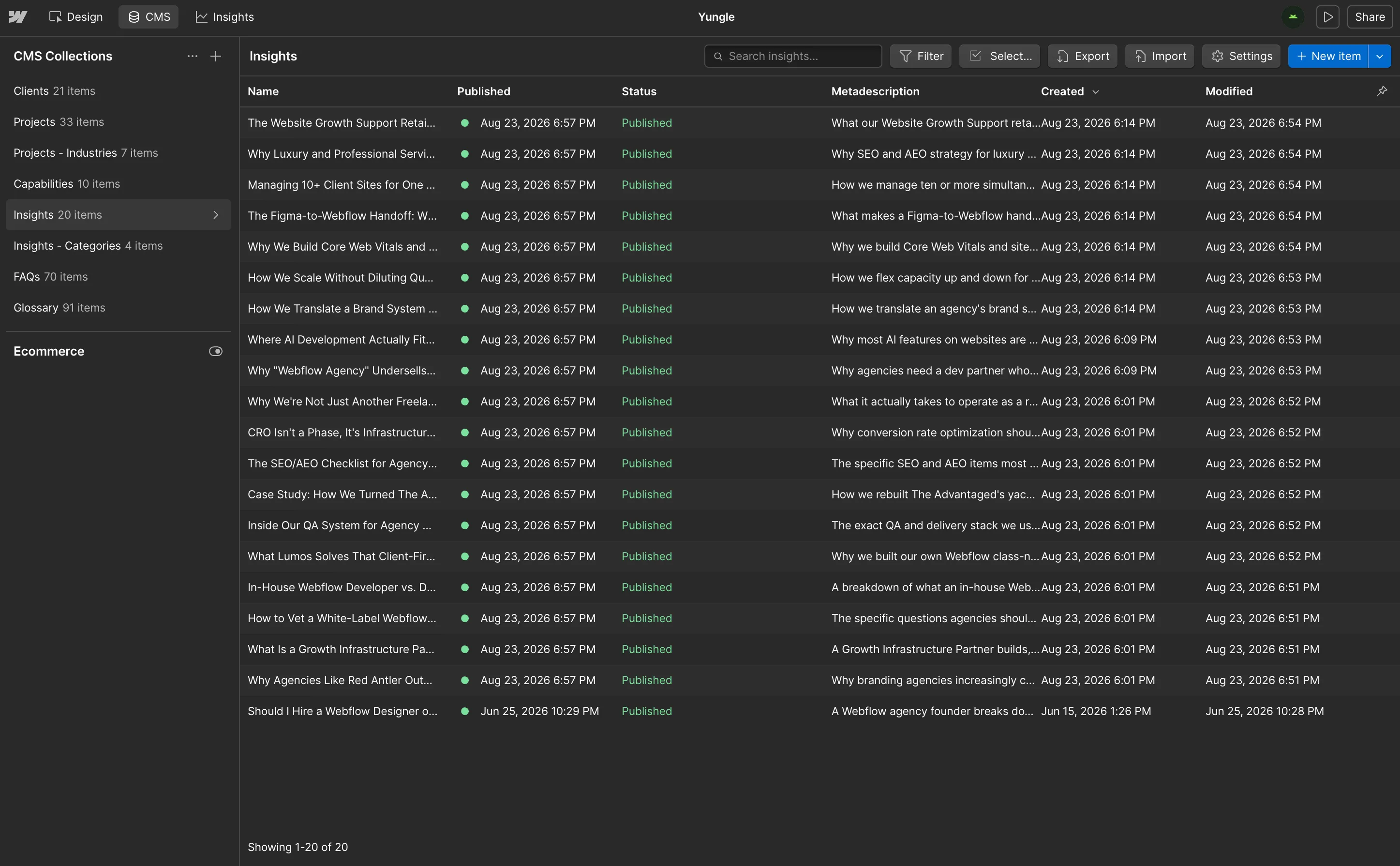
palabras clave
Agencia de growth marketing
Empresa de growth marketing
Servicios de growth hacking
Estrategias de retención de clientes
Growth marketing para SaaS
...
analítica
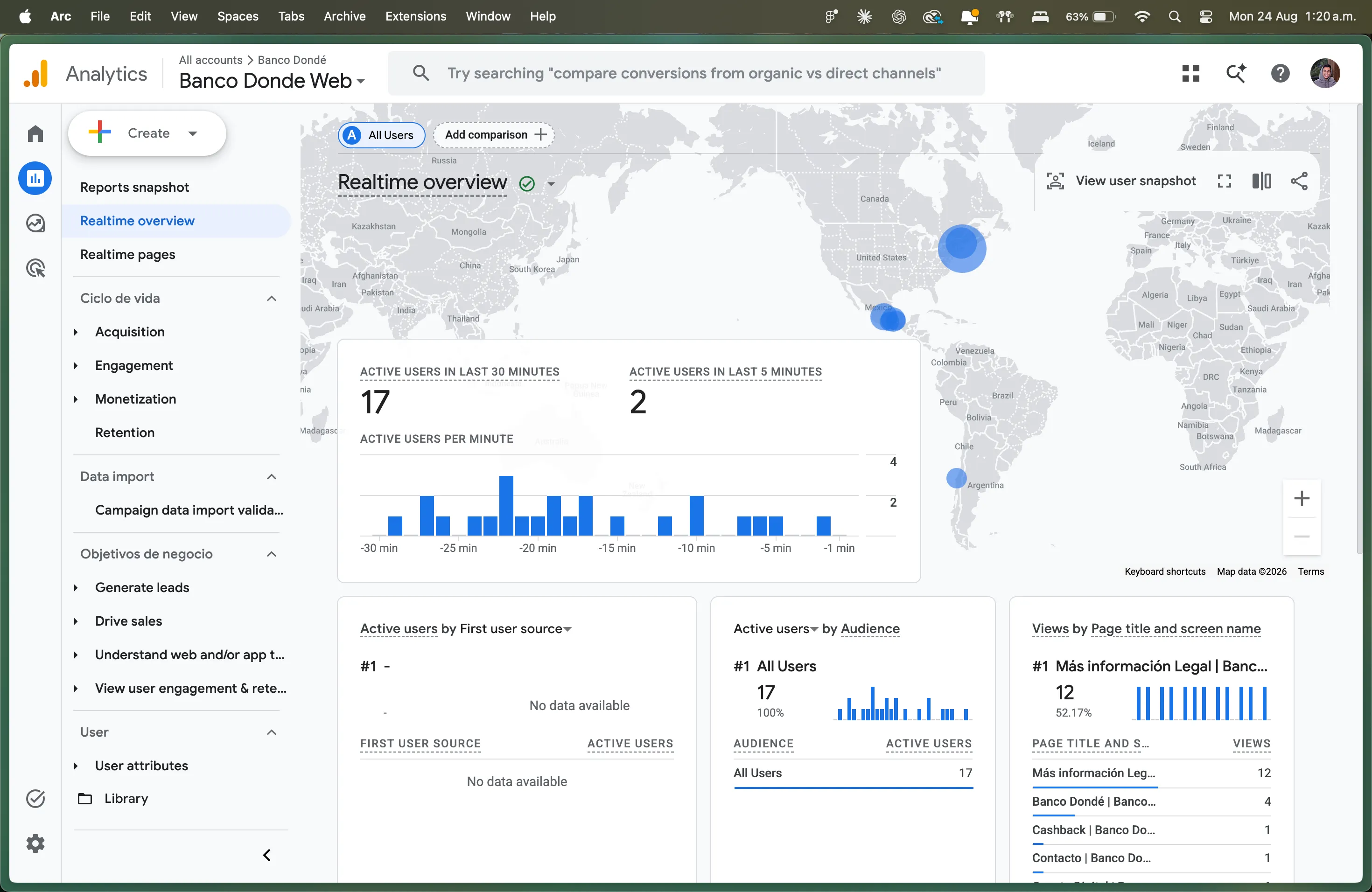
kpis
Eso es lo que hace el Yungle Growth System.
palabras clave
Agencia de growth marketing
Empresa de growth marketing
Servicios de growth hacking
Estrategias de retención de clientes
Growth marketing para SaaS
...
analíticas

CMS
analíticas
Eso es lo que hace el sistema de crecimiento de Yungle.
Un sistema conectado. Cuatro etapas que se potencian.
01 Diseño
02 Desarrollo
03 Visibilidad
04 Optimización

Desde $6,000 USD.
Sistemas de diseño estratégicos creados para el crecimiento, la claridad y la conversión. Cada pantalla está diseñada pensando en el desarrollo, el SEO y la conversión desde el primer día.

Desde $8,000 USD.
Sistemas escalables en Webflow, aplicaciones web e infraestructura digital que los equipos de marketing pueden gestionar sin depender de desarrolladores para cada actualización.



"I find comfort in knowing we'll consistently be able to deliver fantastic Webflow sites for our clients, whatever their needs may be."



"I find comfort in knowing we'll consistently be able to deliver fantastic Webflow sites for our clients, whatever their needs may be."
No somos una agencia.
Somos un socio de infraestructura para el crecimiento.
Cuatro pilares que hacen que el sistema funcione.
Hablamos ambos idiomas
Entendemos de marketing, negocios, diseño y desarrollo. Cerramos la brecha entre lo que una empresa necesita y lo que un equipo de desarrollo construye, para que nada se pierda en el camino.
Construimos para tu equipo, no para nosotros
Cada sistema que creamos está diseñado para que tu equipo de marketing pueda gestionarlo de forma independiente. No queremos que nos necesites para cada actualización. Queremos que tú tengas el control.
Estamos involucrados en el trabajo
Cuando trabajas con Yungle, trabajas directamente con quienes desarrollan las ideas. Sin gerentes de cuenta, sin intermediarios. El equipo que conoces en la llamada de estrategia es el mismo que trabajará en tu proyecto.
Pensamos en lo que sucede después del lanzamiento
Diseño, construcción, visibilidad, optimización: todo el sistema está pensado a largo plazo. Un sitio web que mejora con el tiempo vale exponencialmente más que uno que alcanza su punto máximo el día del lanzamiento.

Reflexiones sobre cómo crecen realmente los sitios web modernos.
Suscríbete a nuestro boletín
Un correo al mes. Con novedades sobre diseño, desarrollo, AEO, CRO y más.





"We've worked together across several projects, and they consistently go above and beyond. They've become our go-to team, and for good reason."



"We've worked together across several projects, and they consistently go above and beyond. They've become our go-to team, and for good reason."
PREGUNTAS FRECUENTES
01
What's the Difference Between an AI Development Partner and a Software Development Agency?
A general software development agency builds applications and features to a defined specification; an AI development partner specializes specifically in systems that reason over data, adapt to new input, and take autonomous action — which requires different architecture, testing, and evaluation approaches than traditional software. The two skill sets overlap, but AI systems need ongoing evaluation for accuracy and drift in ways static software doesn't. Choosing a partner with specific AI production experience matters more here than general development capability alone.
01
Do I Need Both a Web Development Partner and an AI Development Partner?
Increasingly, no — the two are converging, since most AI features (chatbots, personalization, automation) need to be built directly into your website and its data, not bolted on afterward. Splitting web development and AI development across separate vendors often creates integration friction and slower iteration, since neither side fully understands the other's system. A single partner covering both design, development, and AI capability tends to ship faster and produce more coherent systems than coordinating separate teams.
01
How Do I Choose the Right AI Development Partner?
Look for a partner with real production AI experience — not just prototypes — who can explain their architecture choices clearly instead of treating the system as a black box. Ask directly about data ownership, what happens if you want to switch providers later, and how they handle failure cases when the AI gets something wrong. Agencies that can't answer these questions specifically usually haven't shipped AI systems that survived real-world use.
01
What Industries Benefit Most From Custom AI Development?
Industries with high-volume, repetitive tasks and substantial existing documentation see the fastest returns — professional services, real estate, e-commerce, and B2B companies with detailed product or service catalogs are common examples. These businesses tend to have both the data AI needs to work well and clear, measurable processes worth automating. Industries with highly regulated, judgment-heavy work can still benefit, but usually need more careful scoping around where AI assists versus where a human stays fully in control.
01
Can AI Handle Customer Support for My Business?
AI can handle a large share of routine, repetitive support questions well — especially when trained on your actual documentation and past support conversations — freeing your team to focus on complex or high-stakes issues. It's less reliable for emotionally sensitive situations, ambiguous requests, or anything requiring real judgment calls. The most effective setups use AI as the first line of response with a clear, fast handoff to a human when the AI can't confidently resolve something.
01
What Is AI Automation and How Is It Different From Regular Software Automation?
Regular software automation follows fixed, predefined rules — if this happens, do that. AI automation can handle unstructured input, like reading an email or a customer message, understanding intent, and deciding what action to take without every scenario being explicitly programmed in advance. This matters because most real business processes involve exceptions and judgment calls that rigid rule-based automation can't handle well, which is exactly the gap AI automation is built to close.